
Hook Lifts South Africa

TAM Hook lifts
The column lift is driven by a hydraulic cylinder which pushes two 11mm cables over a series of pulleys raising and lowering the main platform

LR-Range Hook Lifts
The SM9, 13 & 16 SKIPLOADER Vehicles are manufactured completely in South Africa with the exception of the hydraulic valves and pump. They are designed for conditions in the local industry andprovide a long and efficient service.
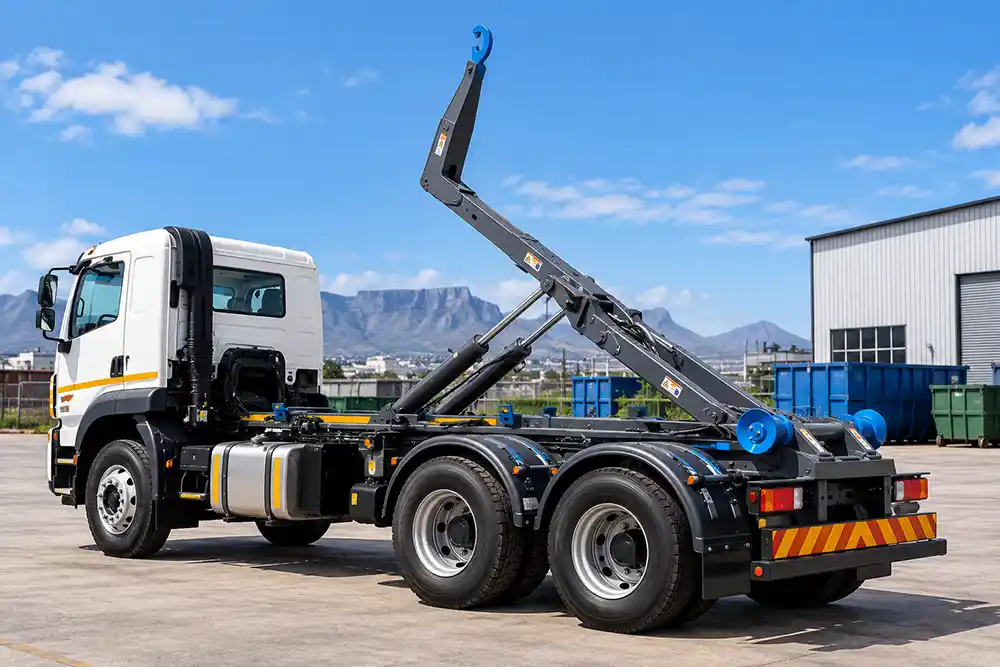
Transtech supplies hook lifts in South Africa for waste management, recycling, scrap, demolition and other operations requiring efficient handling and transport of compatible containers and interchangeable bodies.
A hook lift transforms a suitable truck chassis into a flexible container-handling vehicle. Instead of permanently dedicating the truck to a single fixed body, the hydraulic hook lift system allows compatible containers or bodies to be loaded onto the vehicle, transported to another location and unloaded when required.
This flexibility can be particularly valuable for municipalities, waste management contractors, recycling operations and industrial businesses managing multiple containers across different collection or operating sites.
Transtech supplies hook lift equipment as part of its wider range of waste handling equipment for South African operators.
What Is a Hook Lift?
A hook lift is a hydraulically operated loading system mounted onto a truck chassis. It uses a hook mechanism to engage with a compatible container or interchangeable body and load it onto the vehicle.
The system allows the truck to collect a compatible container from the ground, position it securely on the vehicle for transport and unload it again at the required destination.
This differs from a conventional truck with a permanently mounted load body. With a hook lift, the truck and container can operate as separate assets.
A container can therefore remain at a customer's premises, waste collection point, construction site or industrial facility while the truck moves on to another job.
When that container needs to be collected, the hook lift vehicle can return, load it and transport it to the required disposal, processing or transfer location.
How Does a Hydraulic Hook Lift Work?
The basic purpose of a hydraulic hook lift is to move a compatible container between ground level and the truck chassis.
The vehicle is positioned correctly in relation to the container and the hydraulic loading mechanism is operated so that the hook engages with the container's lifting point.
The hydraulic system then draws the container onto the truck's loading frame. Once correctly loaded and secured, the vehicle can transport the container to its destination.
For unloading, the process is reversed and the container is lowered from the vehicle to the ground in a controlled manner.
This roll-on/roll-off principle provides an efficient method of moving larger containers without requiring a separate crane or permanently mounting every container to its own truck chassis.
Why Use a Hook Lift Truck?
The main reason for choosing a hook lift is operational flexibility.
In a conventional truck configuration, the load body generally remains attached to the vehicle. If the body needs to remain at a site while it is filled, the vehicle may effectively be tied to that body.
A hook lift changes this relationship.
The truck can deliver a compatible container, unload it and leave it at the site. The vehicle can then collect another container or perform another transport task.
This means one hook lift vehicle can potentially operate with a number of compatible containers or interchangeable bodies, depending on the configuration of the equipment and the operator's requirements.
For organisations managing multiple waste collection or material handling points, this can create a more flexible relationship between the fleet and the container network.
Hook Lifts for Waste Management
Waste management is one of the primary applications for hook lift systems.
Instead of requiring waste to be transferred manually into a collection vehicle, a compatible container can be positioned at the location where waste is generated.
Material accumulates in the container and the hook lift vehicle collects it when required.
This approach can be useful for operations where the waste volume, material type or collection method makes smaller wheelie bins or conventional rear-loading refuse collection unsuitable.
Applications can include municipal waste facilities, commercial premises, industrial operations, recycling sites and other locations where larger container-based collection is required.
Hook Lifts for Recycling Operations
Recycling facilities often need to separate different materials before transport or processing.
A container-based handling system can provide a practical way of keeping these material streams separate.
Compatible containers can be positioned for different recyclable materials and collected individually as required.
The hook lift vehicle does not need to remain with a particular container while it is being filled. It can continue working elsewhere and return when the container is ready for transport.
This can make hook lift systems particularly useful where a business manages multiple recycling containers across one or several locations.
Hook Lifts for Scrap Handling
Scrap operations can involve bulky, irregular and heavy materials that require a robust container-based transport system.
Hook lift equipment is commonly associated with this type of work because suitable containers can be positioned where scrap material is generated or stored and transported when required.
The exact hook lift, container and truck configuration needs to be matched to the expected load and operating conditions.
The weight of the material is especially important. Two containers with similar dimensions can have very different loaded weights depending on what they contain.
Hook Lifts for Construction and Demolition
Construction and demolition operations can generate substantial quantities of material over the duration of a project.
Using compatible hook lift containers allows a container to remain on site while waste or material accumulates.
Once ready for removal, the hook lift truck can collect the container and transport it to the appropriate destination.
This can be useful for demolition material, construction waste and other suitable material streams where container-based handling forms part of the site's waste management system.
When equipment is being specified for construction environments, consideration should also be given to site access, ground conditions and the space required for safe loading and unloading.
One Truck, Multiple Compatible Containers
One of the most important features of a hook lift system is the separation between the truck and the load body.
For example, an operator may have several compatible containers positioned at different customer sites while operating a smaller number of hook lift trucks to collect and move them.
The containers remain where the waste or material is generated, while the vehicles remain productive as transport assets.
This can be particularly valuable for a waste contractor servicing multiple customers.
Rather than providing a complete truck to every collection point, compatible containers can be deployed according to customer requirements and collected according to a planned schedule or when full.
Hook Lift Containers and Interchangeable Bodies
The hook lift system and the body or container need to be compatible.
This is a fundamental consideration when specifying the equipment.
The fact that a truck has a hook lift does not mean that every container can automatically be used with it.
Container dimensions, lifting geometry, load requirements and the design of the hook lift system all need to be considered.
If an operator already owns containers, those containers should be evaluated when specifying the hook lift equipment.
If a completely new system is being introduced, it can be beneficial to consider the vehicle, hook lift and intended container network together rather than purchasing each component independently.
Choosing the Right Hook Lift
Selecting a hook lift requires more than deciding that a roll-on/roll-off container system would be useful.
The equipment needs to be matched to the vehicle, containers, expected loads and operating environment.
Before choosing a system, consider the following:
- Type of material being transported
- Expected container dimensions
- Loaded container weight
- Truck chassis configuration
- Required container handling arrangement
- Number of containers in circulation
- Collection frequency
- Operating environment
- Loading and unloading space
- Maintenance and technical support
Defining these requirements before selecting equipment helps ensure that the complete vehicle is suited to the work it will perform.
Container Weight Is an Important Consideration
Container size alone does not determine the load placed on a hook lift vehicle.
The material inside the container can make a substantial difference.
A large container carrying relatively light material can weigh considerably less than a smaller container filled with dense scrap or demolition material.
Buyers should therefore consider realistic loaded container weights rather than specifying equipment according to container volume alone.
The intended payload, vehicle configuration and hook lift system all need to be considered together.
Matching the Hook Lift to the Truck Chassis
The hook lift forms part of a complete vehicle and must be correctly matched to the truck chassis on which it is installed.
Important considerations can include:
- Vehicle size and configuration
- Wheelbase
- Axle configuration
- Permissible loading
- Expected payload
- Hook lift dimensions
- Container dimensions
- Hydraulic requirements
- Operating conditions
The correct specification depends on the particular application and should be established before the equipment is installed.
Transtech can assist customers in evaluating the intended waste handling application and suitable vehicle configuration.
Consider the Operating Environment
Hook lift vehicles can operate in very different environments, from municipal facilities and public roads to recycling yards, industrial premises and construction sites.
The operating environment should therefore form part of the equipment selection process.
Important factors can include:
- Available manoeuvring space
- Ground conditions
- Road access
- Gradients
- Container positioning
- Overhead restrictions
- Traffic around the loading area
- Space required to load and unload the container
A system that works effectively in an open waste facility may face very different constraints when collecting containers from a congested commercial or industrial site.
Hook Lift vs Skip Loader
Hook lifts and skip loaders are both used for container handling, but they should not be treated as interchangeable terms.
A hook lift uses a hydraulic hook mechanism to engage a compatible body or container and draw it onto the vehicle.
A skip loader uses lifting arms and chains to raise a compatible skip onto the truck.
The appropriate system therefore depends heavily on the containers used by the operation.
If the business already operates compatible hook-lift containers or requires interchangeable roll-on/roll-off bodies, a hook lift may be the appropriate system to investigate.
If the operation is centred around traditional compatible skip containers lifted using chains and loading arms, a skip loader may be more suitable.
Transtech supplies both systems through its waste handling equipment range.
Hook Lift vs Refuse Compactor Truck
A hook lift also performs a different role from a conventional refuse compactor truck.
A refuse compactor truck is designed to receive refuse into its loading hopper and compact that waste within the vehicle body.
A hook lift vehicle instead transports compatible containers or interchangeable bodies.
This makes the two vehicle types suitable for different waste collection systems.
Municipal household collection involving wheelie bins and refuse bags will typically require a different vehicle configuration from an industrial site using a large removable container.
Some waste management fleets may therefore use refuse compactors, hook lifts and skip loaders together, with each vehicle performing the collection work for which it is best suited.
Hook Lifts for Municipal Waste Operations
Municipal waste management can involve considerably more than household refuse collection.
Municipalities may need to move larger waste containers, collect material from facilities or transfer waste between different points in the waste management network.
A hook lift can provide an additional container-handling capability alongside conventional refuse collection vehicles.
The appropriate fleet combination depends on the municipality's waste streams, container infrastructure and collection methods.
Hook Lifts for Private Waste Contractors
Private waste management contractors often service customers with very different waste volumes and collection schedules.
A container-based system allows compatible containers to be positioned at customer premises and collected according to the agreed service schedule.
This can provide operational flexibility because the truck itself does not need to remain at the customer's premises while the container is being filled.
When considering a hook lift system, contractors should look beyond their immediate requirements and consider the type of customers and container network they intend to support as the business develops.
Hydraulic Hook Lift Maintenance
A hook lift relies on hydraulic and mechanical components to load and unload containers. Appropriate inspection and maintenance are therefore important for reliable operation.
Maintenance requirements will depend on the specific hook lift system, vehicle and manufacturer's recommendations.
Operators should pay attention to the condition of hydraulic components, structural components, moving parts, container engagement points and associated safety equipment as part of the appropriate maintenance programme.
Equipment should be inspected and serviced according to its specified requirements rather than waiting for a failure to interrupt operations.
Why Parts and Technical Support Matter
A hook lift vehicle may form an important part of an operator's daily collection and transport schedule.
If the vehicle cannot load or unload containers, downtime can affect more than the truck itself. Containers may remain at customer sites and scheduled collections can be delayed.
Long-term support should therefore be considered when selecting waste handling equipment.
Buyers should consider parts availability, maintenance requirements, technical support and the ability to obtain assistance with the equipment after installation.
Plan the Complete Container Handling System
One of the most useful ways to approach a hook lift purchase is to think beyond the truck.
The complete system includes:
- The truck chassis
- The hydraulic hook lift
- The compatible containers or interchangeable bodies
- The material being carried
- The collection sites
- The unloading or processing destination
- The operators using the equipment
- The maintenance and support requirements
All of these elements affect how successfully the equipment will operate in practice.
Planning the complete system also reduces the risk of purchasing a vehicle that later proves incompatible with existing containers or unsuitable for the sites where it needs to work.
Questions to Ask Before Buying a Hook Lift
Before requesting a quotation for a hook lift, gather as much information as possible about the intended application.
- What material will the vehicle transport? Waste type and density influence the expected load.
- Which containers or bodies will be used? Existing and future container requirements should be considered.
- What is the maximum expected loaded weight? Use realistic operating weights rather than empty container weight alone.
- Which truck chassis will be used? The hook lift and chassis need to be correctly matched.
- How many containers will be in circulation? This helps define how the overall collection system will operate.
- Where will containers be positioned? Ensure collection sites provide suitable access and operating space.
- How frequently will they be collected? Collection frequency affects vehicle utilisation and fleet requirements.
- Where will the material be taken? Consider disposal, recycling, transfer and processing destinations.
- What are the site conditions? Ground conditions and manoeuvring space can affect operations.
- What after-sales support is available? Parts and technical assistance are important for long-term operation.
Hook Lifts as Part of a Complete Waste Handling Fleet
There is no single vehicle configuration suitable for every waste handling task.
A rear-loading refuse compactor may be appropriate for residential wheelie-bin collection. A skip loader may be appropriate where traditional skips are used. A hook lift may be better suited to operations built around compatible roll-on/roll-off containers and interchangeable bodies.
For larger operators, these systems can complement each other.
The objective is to match each collection method with the equipment best suited to the containers, material and route involved.
Hook Lifts from Transtech
Transtech supplies specialist municipal and waste handling equipment for South African operators, with experience in the industry dating back to 1984.
The company's broader waste equipment range includes hook lifts, skip loaders, refuse compactor trucks, bin lifters and other equipment used across municipal and private waste management operations.
This allows customers to discuss the hook lift as part of the complete vehicle and waste handling application rather than considering the loading equipment in isolation.
Request a Hook Lift Quote
If you are looking for hook lifts in South Africa, the correct system should be selected according to the containers, material, expected load, truck chassis and operating environment.
Providing this information when requesting a quotation can help Transtech determine which hook lift configuration is appropriate for your application.
Contact Transtech to discuss your hook lift requirements, container handling application and vehicle configuration.