
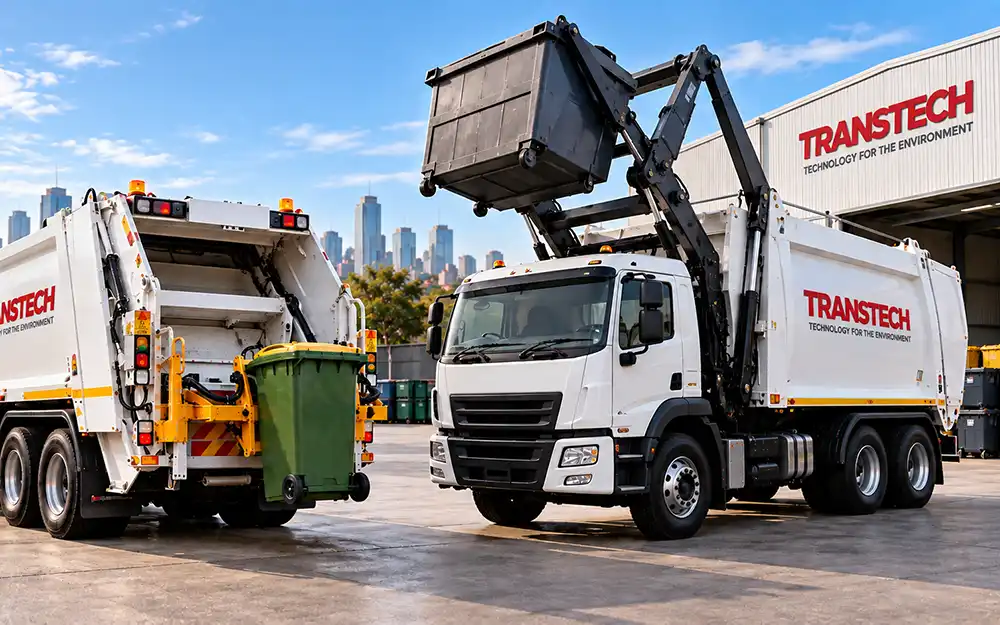
Rear Loader vs Front Loader Refuse Compactor Trucks: Which Is Right for Your Operation?
Choosing between a rear loader and a front loader refuse compactor truck is an important decision for municipalities, waste management contractors and commercial operators.
Both types of refuse compactor are designed to collect, compact and transport waste efficiently, but they are suited to different types of collection work.
The right choice depends on factors such as the type of waste being collected, the containers being used, the collection route, the number of stops per day and whether the vehicle will mainly service residential, municipal, commercial or industrial customers.
This guide explains the main differences between rear loader and front loader refuse compactor trucks and looks at where each type is most suitable.
What Is a Rear Loader Refuse Compactor Truck?
A rear loader refuse compactor receives waste through an opening at the rear of the vehicle.
Waste is placed into a rear hopper and then transferred into the main body by the compaction mechanism.
Rear loaders are widely used for municipal and residential waste collection because they offer considerable flexibility.
They can handle waste collected from wheelie bins, bags and other compatible containers, depending on the configuration of the vehicle and the bin lifting equipment fitted.
For many municipalities and private waste contractors, the rear loader is one of the most versatile refuse collection vehicles available.
What Is a Front Loader Refuse Compactor Truck?
A front loader refuse compactor is designed to lift larger waste containers from the front of the vehicle.
Hydraulic lifting arms engage with a compatible container, raise it above the cab and empty the waste into the body of the truck.
Front loaders are commonly used for commercial and industrial waste collection where large containers are permanently or semi-permanently positioned at customer premises.
Typical applications may include factories, shopping centres, warehouses, office developments and other sites that generate larger volumes of waste.
Because the container is mechanically lifted, front loaders can provide an efficient solution for repeated commercial collection routes.
The Main Difference Between Rear Loaders and Front Loaders
The most obvious difference between the two types of refuse compactor is the loading position.
Rear loaders receive waste from the back of the vehicle, while front loaders lift containers over the cab and empty them into the body from above.
This difference in loading method has a major influence on where each vehicle performs best.
Rear loaders generally provide more flexibility where collection crews deal with many individual bins or bags across residential and municipal routes.
Front loaders are usually better suited to locations where larger commercial containers are collected mechanically.
The decision should therefore be based on the actual collection system rather than on which truck is larger or more powerful.
Rear Loaders for Municipal and Residential Waste Collection
Rear loader refuse compactors are particularly well suited to municipal waste collection.
Residential collection routes often involve a large number of individual collection points, with households presenting wheelie bins or refuse bags for collection.
A rear loader allows collection crews to work behind the vehicle and load waste into the hopper as the truck progresses along the route.
Where compatible bins are used, a bin lifter can be fitted to assist with lifting and emptying the containers.
This reduces the amount of manual handling required and can help improve consistency on routes with large numbers of bins.
Front Loaders for Commercial and Industrial Waste
Front loader refuse compactors are usually chosen for collection systems built around larger waste containers.
Commercial properties often produce waste in higher volumes than individual households, which means larger containers are more practical.
A front loader can approach the container, engage it with the lifting arms, empty it into the compactor body and return it to the collection point.
This can reduce the need for waste collection personnel to manually handle the contents of the container.
Front loaders are therefore commonly associated with commercial and industrial collection operations where speed, repeatability and container compatibility are important.
Consider the Type of Containers You Use
The containers being serviced are one of the most important factors when choosing between a rear loader and a front loader.
Rear loaders can often be configured to handle smaller wheelie bins and other municipal waste containers.
Front loaders are designed around larger containers that can be engaged by the vehicle’s lifting arms.
If an organisation already has a standardised container system, the refuse compactor truck should be selected to work with that system.
If the collection operation is being designed from the ground up, the vehicle and container system should be considered together.
Collection Route Conditions
The physical characteristics of the route also influence vehicle selection.
Rear loaders may be more practical on residential roads where collection points are close together and the vehicle needs to stop frequently.
Front loaders may require more operating space when approaching, lifting and replacing larger commercial containers.
When assessing a route, consider road width, turning space, overhead clearance, traffic conditions and the location of containers.
It is also important to consider whether the truck will operate mainly in dense urban areas, industrial zones, residential neighbourhoods or more widely dispersed commercial locations.
Waste Volume and Collection Capacity
The amount of waste collected during a shift affects the required body capacity and vehicle specification.
High-volume routes may benefit from larger compactor bodies because this can reduce the frequency of trips to disposal facilities.
However, the biggest truck is not automatically the most efficient option.
A larger body may be difficult to operate in confined areas, while a smaller vehicle may reach capacity too quickly on intensive routes.
The objective is to match body capacity to the daily workload, route conditions and chassis limitations.
Loading Speed and Productivity
Waste collection productivity is influenced by more than vehicle capacity.
The speed and efficiency of the loading process can have a significant effect on the number of collection points completed during a shift.
On residential routes, rear loaders can provide a practical workflow for crews servicing many smaller bins.
On commercial routes, front loaders can efficiently service larger containers without requiring extensive manual handling.
The correct loading system can therefore reduce wasted time across an entire collection route.
Bin Lifters and Rear Loader Compactors
Bin lifting equipment can play an important role in rear loader refuse collection.
Transtech supplies a range of bin lifters and bin tippers designed for different container sizes and collection requirements.
Depending on the application, these systems can assist with lifting two-wheeled and four-wheeled bins into the rear hopper.
The correct bin lifter should be selected according to the container sizes used, the daily collection volume and the refuse compactor configuration.
For this reason, the bin lifting system should be considered as part of the complete vehicle specification rather than as an isolated accessory.
Manoeuvrability and Access
Manoeuvrability can be a major consideration, especially in built-up areas.
A rear loader working in residential streets may need to negotiate parked vehicles, intersections and narrow access points.
A front loader may need additional space in front of a container to position the vehicle and operate the lifting arms safely.
Operators should therefore assess the practical access available at collection points before choosing a vehicle configuration.
A truck that performs well in an open industrial yard may not be suitable for a narrow residential route, and vice versa.
Chassis Selection
Both rear loader and front loader refuse compactors need to be matched to an appropriate truck chassis.
The chassis must be suitable for the compactor body, lifting equipment, expected payload and operating conditions.
Factors such as gross vehicle mass, wheelbase, axle loading and overall dimensions can affect the final vehicle specification.
The complete truck should be designed as an integrated system to ensure that the chassis and compactor body are compatible.
Maintenance and Reliability
Refuse compactor trucks work in demanding environments and frequently operate for long hours.
Hydraulic systems, lifting mechanisms, compaction equipment and electrical controls all require appropriate maintenance.
Reliability is especially important because vehicle downtime can disrupt scheduled collections and place additional pressure on the rest of the fleet.
When comparing rear loaders and front loaders, buyers should therefore consider maintenance requirements, parts availability and access to technical support.
Long-term support can be just as important as the initial purchase specification.
Safety Considerations
Waste collection involves personnel, vehicles, moving containers and hydraulic equipment.
The chosen vehicle should support safe operating practices for the intended collection method.
Rear loader crews often work around the back of the vehicle, while front loaders rely heavily on mechanically lifting larger containers.
Operators should be properly trained in the use of the equipment and understand the specific procedures associated with the vehicle.
Appropriate bin lifters and automated lifting equipment can help reduce unnecessary manual handling when correctly specified and operated.
Which Refuse Compactor Is More Versatile?
In many mixed municipal collection environments, rear loaders offer greater versatility because they can handle a wider range of smaller containers and loading methods.
They may be used on residential routes, municipal collections and selected commercial applications.
Front loaders are more specialised but can be extremely efficient in the applications for which they are designed.
For commercial routes based around large standardised containers, a front loader may be the more productive solution.
Versatility should therefore be judged according to the operator’s actual collection requirements.
Can One Fleet Use Both Rear and Front Loaders?
Yes. Larger waste management operations often have different vehicle types within the same fleet.
Rear loaders may be used for residential and municipal routes while front loaders service commercial and industrial customers.
This allows each vehicle to perform the type of work for which it is best suited.
For operators managing a diverse customer base, a mixed fleet can provide greater operational flexibility than attempting to use one vehicle type for every collection application.
Rear Loader vs Front Loader: Key Questions to Ask
Before deciding between a rear loader and a front loader refuse compactor, consider the following questions:
- What type of waste will the vehicle collect?
- Will the route mainly service residential, municipal, commercial or industrial customers?
- What types and sizes of containers are currently being used?
- Will the vehicle need a bin lifting system?
- How many collection points will be serviced per day?
- How much space is available at the collection points?
- What is the expected daily waste volume?
- How far is the disposal or transfer facility?
- What chassis will be used?
- What servicing and technical support will be required?
Answering these questions provides a much clearer basis for selecting the most appropriate refuse compactor truck.
Rear Loader vs Front Loader: Which Should You Choose?
For residential and municipal waste collection involving many smaller bins or bags, a rear loader is often the more practical option.
For commercial and industrial collections involving larger standardised containers, a front loader may offer a more efficient collection method.
The correct decision ultimately depends on the collection system rather than on the truck alone.
Waste type, container size, collection frequency, route design, loading method and vehicle access all need to be considered together.
Refuse Compactor Trucks from Transtech
Transtech has more than 40 years of experience in municipal, waste handling and specialised vehicle equipment.
Customers can be assisted with selecting a refuse compactor configuration suited to their collection requirements, including rear loader and front loader applications.
Transtech also supplies supporting equipment such as bin lifters, together with technical expertise, parts and service support.
For an overview of available refuse collection solutions, visit the Refuse Compactor Trucks for Sale in South Africa page.
Get Advice on the Right Refuse Compactor Configuration
Choosing between a rear loader and a front loader becomes much easier once the actual waste collection operation has been clearly defined.
Consider the containers, route conditions, waste volumes, collection method and chassis requirements before making a final decision.
If you need assistance selecting equipment for a municipal, commercial or industrial waste collection application, contact Transtech to discuss the most suitable refuse compactor configuration for your operation.
Note: Prices and specifications shown are for reference only and may change without notice. For the latest information, please contact Transtech directly on 021 948 4746.